
As a supplier of Vertical Bead Mills, I understand the critical importance of accurately measuring the grinding quality in these machines. The grinding quality directly impacts the final product's performance, whether it's in the paint, ink, pharmaceutical, or other industries. In this blog, I'll share some key methods and considerations for measuring the grinding quality in a Vertical Bead Mill.
Particle Size Analysis
One of the most fundamental ways to measure grinding quality is through particle size analysis. The size of the particles after grinding is a crucial factor that determines the product's properties such as color, gloss, and stability.
There are several techniques available for particle size analysis. Laser diffraction is a widely used method. It works by passing a laser beam through a dispersed sample of the ground material. The particles scatter the laser light at different angles, and the intensity of the scattered light is measured. Based on the scattering pattern, the particle size distribution can be calculated. This method provides rapid and accurate results, covering a wide range of particle sizes.
Another technique is sedimentation analysis. In this method, the sample is suspended in a liquid, and the rate at which the particles settle is measured. Larger particles settle faster than smaller ones. By analyzing the sedimentation rate, the particle size distribution can be determined. However, this method is more time - consuming compared to laser diffraction and is more suitable for larger particle sizes.
Microscopy can also be used for particle size analysis. Optical microscopy can provide a visual representation of the particles, allowing for direct measurement of their size. Electron microscopy, such as scanning electron microscopy (SEM) or transmission electron microscopy (TEM), can provide even higher resolution images, enabling the analysis of very small particles. However, microscopy is a more labor - intensive method and may not be suitable for large - scale production monitoring.
Viscosity Measurement
Viscosity is another important parameter to measure the grinding quality. The viscosity of the ground material is related to the particle size, shape, and concentration. During the grinding process, as the particles are reduced in size, the viscosity of the suspension may change.
A viscometer is used to measure the viscosity of the material. There are different types of viscometers, such as rotational viscometers and capillary viscometers. Rotational viscometers work by measuring the torque required to rotate a spindle immersed in the sample. Capillary viscometers measure the time it takes for a fixed volume of the sample to flow through a capillary tube.
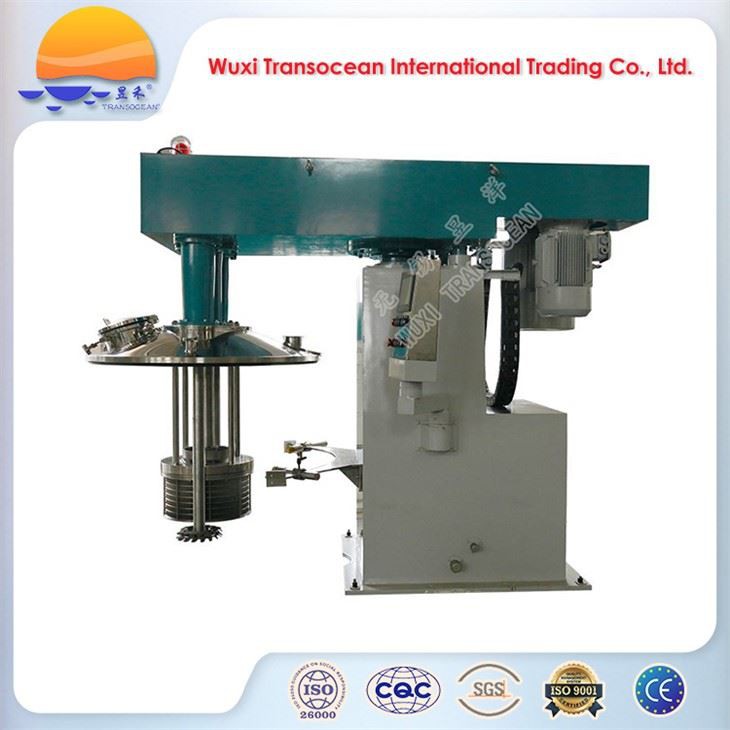

In a Vertical Bead Mill, if the grinding is effective, the viscosity should reach a stable and appropriate value for the final product. An abnormal increase or decrease in viscosity may indicate problems with the grinding process, such as over - grinding or insufficient grinding.
Colorimetry
Color is an important characteristic of many products, especially in the paint and ink industries. Colorimetry is used to measure the color of the ground material. A colorimeter or a spectrophotometer can be used for this purpose.
A colorimeter measures the color based on the three primary color components: red, green, and blue. It provides a numerical value for the color, which can be compared to a standard color. A spectrophotometer, on the other hand, measures the reflectance or transmittance of light at different wavelengths across the visible spectrum. This provides more detailed information about the color and can be used to detect subtle color changes.
In a Vertical Bead Mill, proper grinding is essential to achieve the desired color. If the particles are not ground to the appropriate size, the color of the final product may be off - shade. By regularly measuring the color of the ground material, the grinding quality can be monitored, and adjustments can be made to the grinding process if necessary.
Homogeneity Assessment
Homogeneity refers to the uniformity of the particle distribution in the ground material. A homogeneous product ensures consistent performance. There are several ways to assess the homogeneity of the ground material.
One method is to take multiple samples from different parts of the batch and analyze their particle size, viscosity, or color. If the results are consistent across all samples, the product is considered homogeneous. Another approach is to use imaging techniques, such as confocal microscopy or X - ray tomography, to visualize the internal structure of the material and detect any inhomogeneities.
In a Vertical Bead Mill, factors such as the agitation speed, bead size, and milling time can affect the homogeneity of the ground material. By optimizing these parameters, a more homogeneous product can be achieved.
Considerations for Measuring Grinding Quality
When measuring the grinding quality in a Vertical Bead Mill, there are several considerations to keep in mind.
First, the sampling method is crucial. The samples should be representative of the entire batch. Sampling should be done at different stages of the grinding process and from different locations within the mill to ensure accurate results.
Second, the measurement equipment should be properly calibrated. Regular calibration of particle size analyzers, viscometers, colorimeters, etc., is necessary to ensure the accuracy of the measurements.
Third, the operating conditions of the Vertical Bead Mill, such as the temperature, pressure, and flow rate, can affect the grinding quality. These conditions should be carefully controlled and monitored during the measurement process.
Related Equipment
If you are interested in other types of grinding equipment, we also offer a variety of options. For example, the Printing Ink Basket Mill is suitable for the grinding and dispersion of printing inks. The Horizontal Pin Type Bead Mill provides high - efficiency grinding for a wide range of applications. And the Dispersing Grinding Mill combines the functions of dispersion and grinding.
Conclusion
Measuring the grinding quality in a Vertical Bead Mill is a multi - faceted process that involves particle size analysis, viscosity measurement, colorimetry, and homogeneity assessment. By accurately measuring these parameters, the grinding quality can be effectively monitored and controlled, ensuring the production of high - quality products.
If you are looking for a reliable Vertical Bead Mill or have any questions about measuring grinding quality, please feel free to contact us for further discussion and potential procurement. We are committed to providing you with the best solutions for your grinding needs.
References
- ASTM International. Standard Test Methods for Particle Size Analysis of Soils. ASTM D422 - 63(2007)e1.
- ISO 3219:1993. Plastics -- Polymers/resins in the liquid state or as emulsions or dispersions -- Determination of viscosity using a rotational viscometer with defined shear rate.
- Hunter, R. S. (1975). The Measurement of Appearance. Wiley - Interscience.


