
Hey there! As a supplier of Three Roll Mills, I often get asked about the throughput of these machines. So, I thought I'd take a moment to break it down for you.
First off, let's understand what throughput means in the context of a Three Roll Mill. Simply put, throughput refers to the amount of material that a mill can process within a given period of time. It's a crucial factor when it comes to determining the efficiency and productivity of the mill, especially in industrial settings where large - scale production is the norm.
The throughput of a Three Roll Mill can vary significantly depending on several key factors. One of the most important factors is the viscosity of the material being processed. If you're dealing with a low - viscosity material, like a thin liquid paint, the mill can generally handle a higher throughput. This is because low - viscosity materials flow more easily between the rollers, allowing for a quicker and more efficient grinding process.
On the other hand, high - viscosity materials, such as thick pastes or heavy greases, pose more of a challenge. These materials don't flow as readily, and they require more force to be pushed through the gaps between the rollers. As a result, the throughput of the mill decreases when processing high - viscosity substances. It might take longer for the material to pass through the mill, and you may need to adjust the speed and pressure settings to ensure proper grinding.
The size of the mill also plays a major role in determining throughput. Larger Three Roll Mills typically have a higher throughput capacity. This is because they have larger rollers, which means a greater surface area for the material to come into contact with. More surface area allows for more material to be processed at once. For example, a large - scale industrial Triple Roller Grinder can handle a much larger volume of material per hour compared to a smaller, bench - top model.
Another factor that affects throughput is the gap between the rollers. The gap setting determines the fineness of the grind. A smaller gap will result in a finer grind, but it will also reduce the throughput. This is because a smaller gap restricts the amount of material that can pass through the rollers at one time. If you need a very fine particle size, you'll have to sacrifice some throughput. Conversely, if you can tolerate a coarser grind, you can increase the gap between the rollers, which will allow more material to pass through and increase the throughput.
The speed of the rollers is yet another consideration. Faster roller speeds generally lead to higher throughput, but there's a limit. If you increase the speed too much, the material may not be properly ground, and you could end up with inconsistent particle sizes. You need to find the right balance between speed and quality of the grind.
Let's talk about some real - world applications. In the pigment industry, Pigment Paste Three Roll Mill are commonly used. Pigment pastes can have a wide range of viscosities, and the throughput of the mill will depend on the specific characteristics of the paste. For water - based pigment pastes with relatively low viscosity, a well - adjusted Three Roll Mill can achieve a decent throughput. However, for solvent - based or highly concentrated pigment pastes, the throughput may be lower due to their higher viscosity.
In the coating industry, Coating Three Roller Grinding Mill are essential. Coatings can vary from thin, clear lacquers to thick, textured finishes. Thin coatings can be processed more quickly, resulting in a higher throughput. But thick, high - solids coatings will slow down the mill and reduce the throughput.
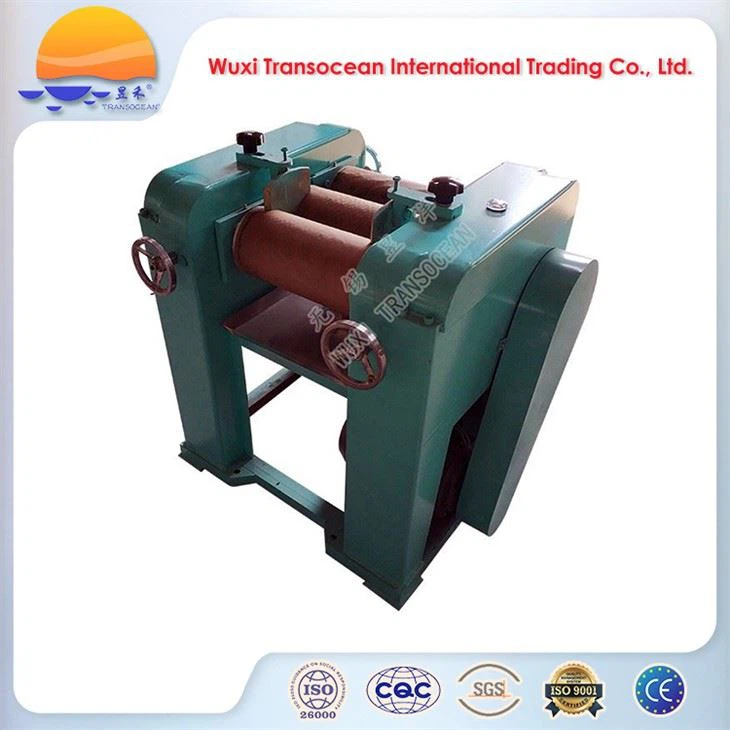

Now, if you're in the market for a Three Roll Mill, it's important to consider your specific throughput requirements. You need to think about the type of materials you'll be processing, the desired particle size, and the volume of production. If you have high - volume production needs, you'll want to invest in a larger mill with a higher throughput capacity. But if you're doing small - scale research or prototyping, a smaller, more affordable mill might be sufficient.
As a supplier, I can help you choose the right Three Roll Mill for your needs. We have a wide range of models available, each designed to meet different throughput requirements. Whether you're looking for a mill for pigment grinding, coating production, or any other application, we've got you covered.
If you're interested in learning more about our Three Roll Mills or want to discuss your specific throughput needs, don't hesitate to reach out. We're here to answer your questions and help you make the best decision for your business.
In conclusion, the throughput of a Three Roll Mill is influenced by multiple factors, including material viscosity, mill size, roller gap, and roller speed. Understanding these factors will help you optimize the performance of your mill and achieve the desired production levels. So, if you're ready to take your production to the next level, let's start the conversation!
References
- "Principles of Grinding in Three Roll Mills" - Industry Handbook
- "Materials Processing with Three Roll Mills" - Research Paper


