
In the realm of wet grinding equipment, three roll mills stand out as indispensable tools for achieving fine particle size reduction and dispersion in various industries such as paints, coatings, inks, and pharmaceuticals. As a seasoned three roll mill supplier, I've witnessed firsthand the distinct characteristics and applications of hydraulic and mechanical three roll mills. This blog post aims to delve into the differences between these two types of mills, helping you make an informed decision when it comes to selecting the right equipment for your specific needs.
Operating Principle
The fundamental difference between hydraulic and mechanical three roll mills lies in their operating mechanisms. A mechanical three roll mill relies on a mechanical system, typically a gearbox, to drive the rotation of the three horizontally arranged rollers. The rollers are set at different speeds, creating a shearing force between them. As the material is fed into the gap between the first two rollers, it is subjected to intense shearing and grinding forces, gradually reducing the particle size. The ground material then moves to the gap between the second and third rollers for further refinement before being discharged.
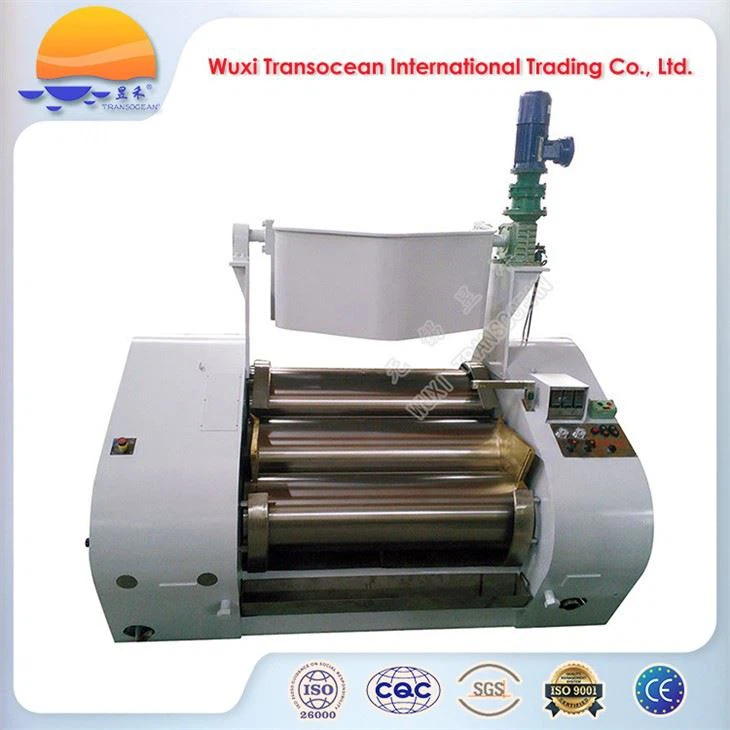
On the other hand, a Hydraulic Three Roll Grinding Mill utilizes a hydraulic system to control the movement and pressure of the rollers. The hydraulic cylinders apply precise pressure to the rollers, allowing for more accurate adjustment of the gap between the rollers. This results in a more consistent and uniform grinding process, especially when dealing with materials that require high precision and fine particle size reduction.
Pressure and Force Application
One of the key advantages of a hydraulic three roll mill is its ability to apply higher and more consistent pressure compared to a mechanical three roll mill. In a mechanical mill, the pressure is limited by the mechanical components, such as the gears and bearings. As a result, the maximum pressure that can be applied is relatively lower, which may not be sufficient for grinding some tough or high-viscosity materials.
In contrast, a hydraulic system can generate much higher pressure, enabling the mill to handle a wider range of materials, including those with high hardness and viscosity. The hydraulic pressure can be easily adjusted according to the specific requirements of the material being processed, ensuring optimal grinding results. Moreover, the hydraulic system provides a more stable and uniform pressure distribution across the rollers, reducing the risk of uneven grinding and improving the overall quality of the finished product.

Precision and Control
Precision is crucial in many industries, especially in applications where a high degree of particle size control is required. A hydraulic three roll mill offers superior precision and control compared to a mechanical mill. The hydraulic system allows for precise adjustment of the roller gap, typically with an accuracy of up to a few micrometers. This level of precision is essential for producing products with consistent particle size distribution, which is critical for achieving the desired performance and quality.
In a mechanical three roll mill, the adjustment of the roller gap is often more difficult and less accurate. It usually involves manual adjustment using mechanical screws or levers, which can be time-consuming and prone to human error. Additionally, the mechanical components may wear over time, leading to changes in the roller gap and affecting the grinding performance.
Maintenance and Durability
Maintenance is an important consideration when choosing a three roll mill. Mechanical three roll mills generally have a simpler design and fewer components compared to hydraulic mills. This makes them easier to maintain and repair, as there are fewer parts that can potentially fail. However, the mechanical components, such as gears and bearings, are subject to wear and tear, especially under high loads and continuous operation. Regular lubrication and replacement of worn parts are necessary to ensure the smooth operation of the mill.
Hydraulic three roll mills, on the other hand, have a more complex hydraulic system. While the hydraulic components are designed to be durable and reliable, they require more careful maintenance. The hydraulic fluid needs to be changed regularly to prevent contamination and ensure proper functioning of the system. Additionally, the hydraulic cylinders and seals may need to be inspected and replaced periodically to avoid leaks and maintain the pressure integrity.
In terms of durability, hydraulic three roll mills are often more robust and can withstand higher loads and longer operating hours. The hydraulic system provides a more stable and consistent operation, reducing the stress on the mechanical components and extending the lifespan of the mill.
Cost
Cost is always a factor in any purchasing decision. Generally, hydraulic three roll mills are more expensive than mechanical three roll mills. The higher cost is mainly due to the more complex hydraulic system and the advanced control technology. However, it's important to consider the long-term benefits and cost savings that a hydraulic mill can offer. The improved precision, higher productivity, and better product quality can often justify the initial investment, especially for large-scale production and high-value applications.
Applications
Both hydraulic and mechanical three roll mills are widely used in various industries, but they are often preferred for different applications based on their characteristics. Mechanical three roll mills are commonly used in applications where the particle size requirements are not extremely strict and the material is relatively easy to grind. They are suitable for small to medium-scale production in industries such as general paints, inks, and adhesives.
Hydraulic three roll mills, on the other hand, are the preferred choice for applications that require high precision and fine particle size reduction. They are commonly used in industries such as high-performance coatings, pharmaceutical creams, and electronic pastes. For example, a Coating Three Roller Grinding Mill or a Triple Roller Mill for Paint may often be a hydraulic mill to ensure the quality and performance of the final product.
Conclusion
In conclusion, the choice between a hydraulic and a mechanical three roll mill depends on several factors, including the specific application, the required precision, the type of material to be processed, and the budget. While mechanical three roll mills offer simplicity and lower cost, hydraulic three roll mills provide superior precision, control, and performance, especially for demanding applications.
As a three roll mill supplier, I understand the importance of choosing the right equipment for your business. Whether you need a mechanical or a hydraulic three roll mill, I can provide you with professional advice and high-quality products to meet your specific needs. If you are interested in learning more about our three roll mills or would like to discuss your requirements, please feel free to contact us. We look forward to working with you to achieve your production goals.
References
- Smith, J. (2020). Three Roll Mills: Principles and Applications. Industrial Grinding Journal, 15(2), 34-45.
- Johnson, A. (2019). Comparison of Hydraulic and Mechanical Grinding Equipment. Manufacturing Technology Review, 22(3), 67-78.
- Brown, R. (2018). Advances in Three Roll Mill Technology. Process Engineering Magazine, 18(4), 56-65.


