
In the world of industrial mixing and grinding, selecting the right equipment is crucial for achieving optimal results. Among the various options available, the three - roll mill stands out as a highly effective and versatile solution. As a reputable three - roll mill supplier, I have witnessed firsthand the numerous advantages that this equipment offers over other mixing alternatives. In this blog post, I will delve into the key benefits of using a three - roll mill and explain why it is the preferred choice for many industries.
Superior Particle Size Reduction
One of the most significant advantages of a three - roll mill is its ability to achieve exceptional particle size reduction. The principle behind a three - roll mill is simple yet highly effective. It consists of three horizontally arranged rollers that rotate at different speeds. The material is fed between the first two rollers, and as it passes through the narrow gaps between the rollers, it is subjected to intense shearing and grinding forces.
This shearing action breaks down agglomerates and reduces the particle size of the material to a very fine level. Compared to other mixing equipment such as paddle mixers or high - speed dispersers, the three - roll mill can produce much smaller and more uniform particle sizes. For applications where fine particle size is critical, such as in the production of inks, paints, and pharmaceuticals, the three - roll mill is the ideal choice.
For example, in the ink industry, a fine particle size is essential for achieving high - quality print results. A three - roll mill can ensure that the pigment particles are evenly dispersed and reduced to a size that allows for smooth and consistent printing. Similarly, in the pharmaceutical industry, the three - roll mill can be used to grind active ingredients into a fine powder, which improves their bioavailability and effectiveness.
Excellent Dispersion Quality
In addition to particle size reduction, the three - roll mill also offers excellent dispersion quality. Dispersion refers to the process of evenly distributing one substance (such as a pigment or filler) throughout another (such as a liquid binder). A good dispersion is essential for achieving consistent product quality and performance.
The shearing forces generated by the three - roll mill help to break down agglomerates and ensure that the particles are evenly distributed in the liquid medium. This results in a more homogeneous mixture with fewer visible clumps or streaks. Other mixing equipment may not be able to achieve the same level of dispersion, especially when dealing with high - viscosity materials or difficult - to - disperse substances.
For instance, in the production of coatings, a well - dispersed coating formulation is crucial for achieving good adhesion, gloss, and durability. The Coating Three Roller Grinding Mill can effectively disperse pigments and additives in the coating resin, resulting in a high - quality coating product.
Precise Control over Processing Parameters
Another advantage of using a three - roll mill is the precise control it offers over processing parameters. The gap between the rollers can be accurately adjusted, allowing for precise control over the shearing forces and the particle size reduction. This means that operators can fine - tune the process to meet the specific requirements of different materials and applications.
The speed of the rollers can also be adjusted independently, providing additional control over the processing conditions. By varying the roller speeds, operators can optimize the shearing forces and the residence time of the material between the rollers. This level of control is not always possible with other mixing equipment, which may have limited adjustment options.
For example, when processing a heat - sensitive material, the operator can adjust the roller speeds and the gap to minimize the heat generated during the grinding process. This helps to prevent thermal degradation of the material and ensures that the final product maintains its quality and properties.
Versatility
Three - roll mills are highly versatile and can be used to process a wide range of materials, including high - viscosity substances. They can handle materials such as pastes, gels, and creams, which may be difficult to process with other types of mixing equipment. This versatility makes the three - roll mill suitable for a variety of industries, including the chemical, food, and cosmetic industries.

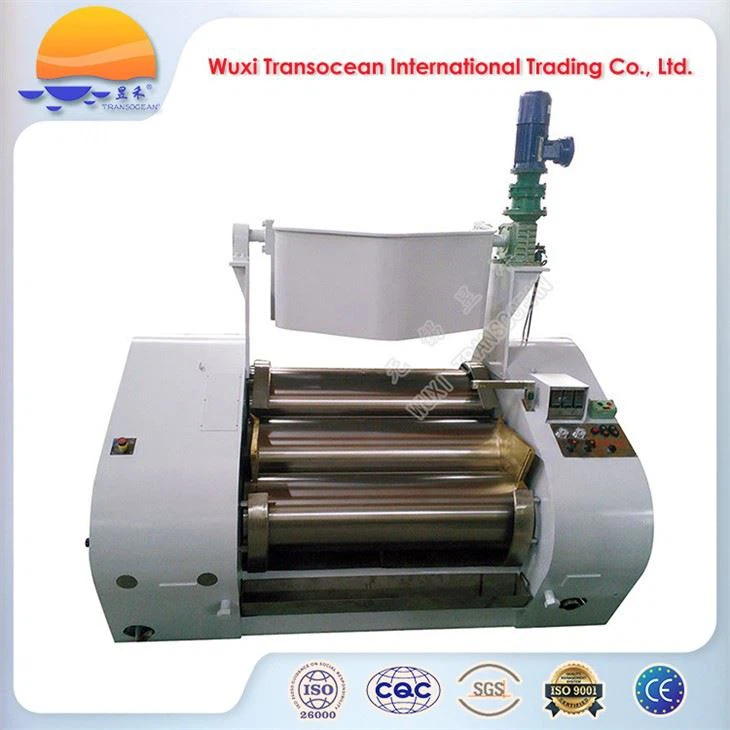
In the chemical industry, the three - roll mill can be used to process polymers, adhesives, and sealants. In the food industry, it can be used to grind and mix ingredients for products such as chocolate, peanut butter, and mayonnaise. In the cosmetic industry, the three - roll mill can be used to produce creams, lotions, and makeup products.
The Triple Roller Grinder is a type of three - roll mill that is particularly well - suited for processing high - viscosity materials. It can handle materials with viscosities up to several million centipoise, making it a popular choice for industries that deal with thick and sticky substances.
Energy Efficiency
Compared to some other types of mixing and grinding equipment, three - roll mills can be relatively energy - efficient. The design of the three - roll mill allows for efficient use of energy, as the shearing forces are concentrated in the narrow gaps between the rollers. This means that less energy is wasted on unnecessary agitation or movement of the material.
In addition, the ability to precisely control the processing parameters of the three - roll mill can also contribute to energy savings. By optimizing the roller speeds and the gap, operators can achieve the desired particle size reduction and dispersion with the minimum amount of energy input.
For example, in a large - scale production facility, using a three - roll mill instead of a less efficient mixing equipment can result in significant energy savings over time. This not only reduces operating costs but also makes the production process more environmentally friendly.
Durability and Low Maintenance
Three - roll mills are typically built to be robust and durable. They are constructed with high - quality materials and precision - engineered components, which can withstand the rigors of continuous operation. This means that they have a long service life and can provide reliable performance over an extended period.
In addition, the maintenance requirements of three - roll mills are relatively low. The rollers are the main wear components, but they can be easily replaced when necessary. The simple design of the three - roll mill also makes it easy to clean and maintain, which helps to ensure consistent product quality.
For example, a well - maintained Hydraulic Three Roll Grinding Mill can operate for many years without major breakdowns, providing a cost - effective solution for industrial mixing and grinding applications.
Conclusion
In conclusion, the three - roll mill offers a multitude of advantages over other mixing equipment. Its superior particle size reduction, excellent dispersion quality, precise control over processing parameters, versatility, energy efficiency, and durability make it the preferred choice for many industries.
If you are in the market for a reliable and high - performance mixing and grinding solution, I encourage you to consider our range of three - roll mills. Our experienced team can help you select the right equipment for your specific application and provide you with comprehensive support and service. Contact us today to start a discussion about your requirements and explore how our three - roll mills can enhance your production process.
References
- "Industrial Mixing and Blending Technology" by Paul E. Baldi
- "Principles of Colloid and Surface Chemistry" by Daniel J. Shaw
- Technical literature from leading three - roll mill manufacturers.


