
Selecting the right three roll mill for different material viscosities can be a real head - scratcher. But don't worry! As a three roll mill supplier, I've got some tips and tricks up my sleeve to help you make the best choice.
Let's start by understanding what viscosity is. In simple terms, viscosity is how thick or thin a material is. Think of honey and water. Honey is thick and has high viscosity, while water is thin and has low viscosity. Different materials with various viscosities require different types of three roll mills to achieve the best grinding and dispersion results.
Low - Viscosity Materials
Materials with low viscosity, like some solvents, light oils, and certain water - based solutions, flow easily. For these materials, you need a three roll mill that can handle the fast - flowing nature without sacrificing on the grinding quality.
A Triple Roller Grinder is often a great option. Its design allows for quick processing of low - viscosity substances. The rollers can rotate at relatively high speeds, and the low - viscosity material can pass through the gaps between the rollers smoothly. This type of mill can efficiently break down any agglomerates and disperse particles evenly in the low - viscosity medium.
One of the key factors to consider when using a triple roller grinder for low - viscosity materials is the gap setting between the rollers. Since the material flows easily, a slightly wider gap can be used initially. However, you still need to adjust it carefully to ensure the desired level of fineness. If the gap is too wide, the grinding effect may not be sufficient, and if it's too narrow, it could cause unnecessary pressure on the mill and potentially damage the rollers.
Medium - Viscosity Materials
Medium - viscosity materials, such as some inks, paints, and adhesives, are a bit more challenging to handle compared to low - viscosity ones. They are thick enough to hold their shape to some extent but still flow under moderate pressure.
A Coating Three Roller Grinding Mill is well - suited for these materials. It offers more precise control over the grinding process. The rollers can be adjusted to apply the right amount of pressure on the medium - viscosity material. This pressure is crucial for breaking down the larger particles and achieving a smooth and consistent dispersion.
When dealing with medium - viscosity materials, the surface finish of the rollers also matters. A smooth roller surface can help the material flow more evenly between the rollers, reducing the chances of clogging. Additionally, the speed of the rollers needs to be carefully regulated. Too high a speed may cause the material to splash or not be ground properly, while too low a speed can lead to inefficient processing.
High - Viscosity Materials
High - viscosity materials, like some rubber compounds, thick pastes, and certain heavy - duty coatings, are extremely thick and resistant to flow. Grinding and dispersing these materials require a powerful and robust three roll mill.
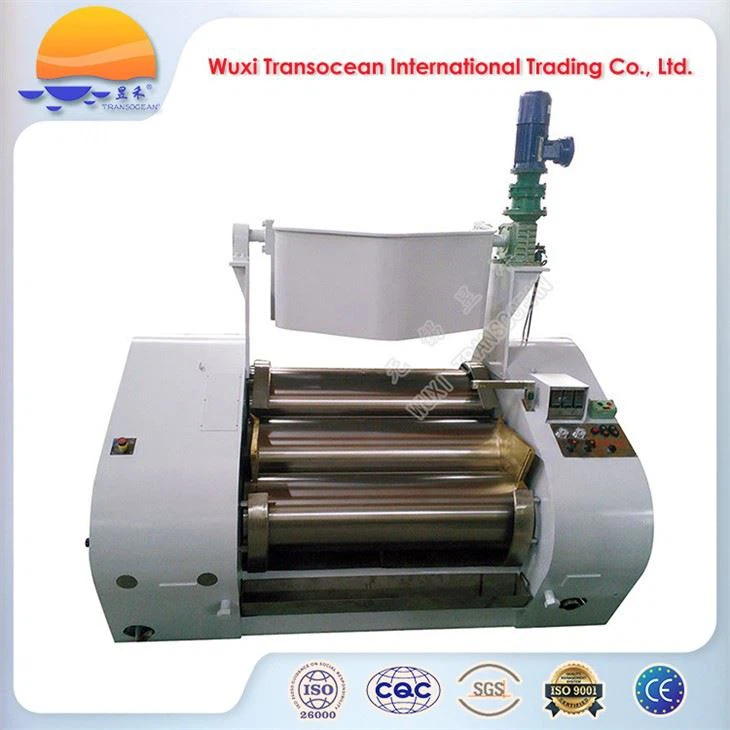
The Hydraulic Three Roll Grinding Mill is the go - to option for high - viscosity substances. It uses hydraulic pressure to apply a large amount of force on the rollers. This force is necessary to break through the thick consistency of the material and achieve effective grinding.
The gap between the rollers in a hydraulic three roll grinding mill needs to be set very precisely. Since high - viscosity materials are difficult to push through, a smaller gap can be used, but you have to be careful not to over - stress the mill. Also, the temperature control of the mill is important when working with high - viscosity materials. The friction generated during the grinding process can cause the temperature to rise, which may affect the properties of the material. So, a mill with good temperature control features can ensure consistent results.
Other Considerations
Apart from the viscosity of the material, there are a few other things to keep in mind when selecting a three roll mill.
The capacity of the mill is an important factor. If you have a large - scale production, you'll need a mill with a higher capacity. On the other hand, if you're doing small - batch production or R & D work, a smaller - capacity mill may be sufficient.
The quality of the rollers is also crucial. High - quality rollers made from durable materials can withstand the wear and tear of continuous grinding. They can also provide a more consistent grinding surface, which is essential for achieving uniform particle size distribution in the material.
Maintenance is another aspect that shouldn't be overlooked. A three roll mill that is easy to clean and maintain can save you a lot of time and money in the long run. Look for mills with accessible parts and clear instructions for maintenance.
Conclusion
Selecting the appropriate three roll mill for different material viscosities is all about understanding the characteristics of your material and matching them with the right mill features. Whether you're dealing with low - viscosity solvents, medium - viscosity inks, or high - viscosity rubber compounds, there's a three roll mill out there that can meet your needs.

If you're still not sure which three roll mill is the best fit for your materials, don't hesitate to reach out. As a three roll mill supplier, I'm here to help you make an informed decision. We can discuss your specific requirements in detail and find the perfect mill for your production process. Contact us to start the conversation and take your grinding and dispersion operations to the next level.
References
- "Industrial Grinding and Dispersion Technologies" by John Smith
- "Handbook of Viscosity and Rheology in Materials Processing" by Jane Doe


