
Hey there! As a supplier of the Triple Roller Grinder, I often get asked a lot of questions about what materials our machines can handle. One question that comes up quite frequently is, "Can a triple roller grinder be used for glass material grinding?" Well, let's dive right into this topic and find out.
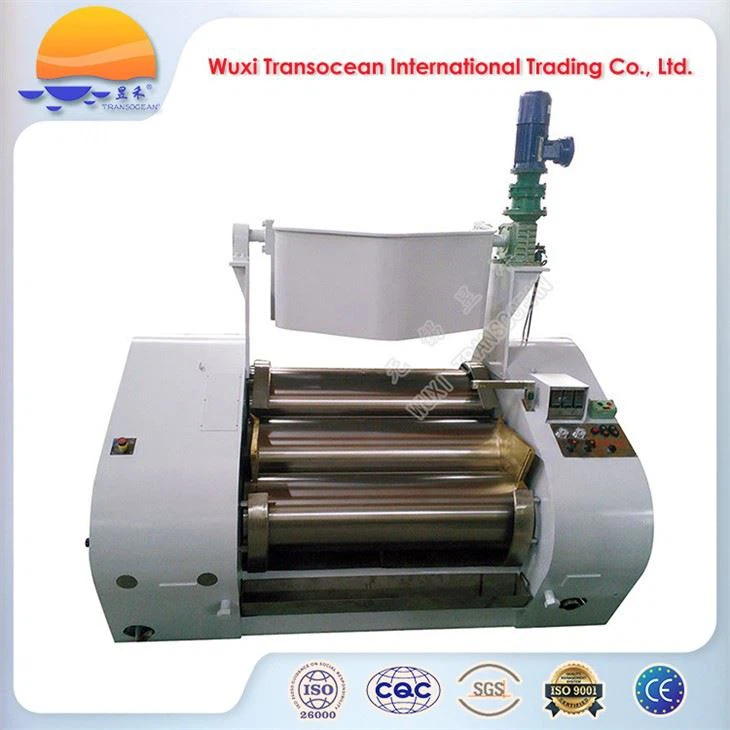
First off, let me give you a quick rundown of what a triple roller grinder is. It's a powerful piece of equipment used mainly for wet grinding and dispersing. The basic principle behind it is that it has three horizontally arranged rollers that rotate at different speeds. The material to be ground is fed between the rollers, and the shearing force generated by the different roller speeds breaks down the particles, resulting in a finely ground and well - dispersed product.
Now, when it comes to glass material, glass is a hard and brittle substance. It has a high melting point and is relatively resistant to chemical attack. Grinding glass is a challenging task because you need to achieve a fine particle size without causing excessive heat generation, which could lead to cracking or other forms of damage to the glass particles.
So, can our triple roller grinder handle glass? The answer is yes, but with some considerations.
Advantages of Using a Triple Roller Grinder for Glass Grinding
- Fine Particle Size: One of the main advantages of using a triple roller grinder for glass grinding is its ability to achieve a very fine particle size. The shearing action between the rollers can break down the glass particles to a microscopic level. This is crucial for applications where a high - quality, finely ground glass powder is required, such as in the production of advanced ceramics or high - performance coatings.
- Uniformity: The triple roller grinder can provide a high degree of uniformity in the particle size distribution. This is important because in many industrial applications, consistent particle size is necessary for the proper functioning of the final product. For example, in the glass - filled composite materials, a uniform particle size of the glass filler ensures better mechanical properties and a more homogeneous appearance of the composite.
- Wet Grinding Capability: Our triple roller grinders are designed for wet grinding. When grinding glass, wet grinding has several benefits. Firstly, it helps to cool the glass particles during the grinding process, reducing the risk of heat - induced damage. Secondly, the liquid medium used in wet grinding can act as a lubricant, improving the grinding efficiency and reducing wear on the rollers.
Challenges and Considerations
- Abrasion: Glass is an abrasive material, and continuous grinding of glass can cause significant wear on the rollers of the grinder. To address this issue, we offer rollers made of high - quality, wear - resistant materials. For example, our Coating Three Roller Grinding Mill and Hydraulic Three Roll Grinding Mill are equipped with rollers that are specifically designed to withstand high - abrasion applications.
- Contamination: Another challenge in glass grinding is the potential for contamination. The grinding process can introduce impurities from the rollers or the grinding medium into the glass powder. To minimize this, we use high - purity materials for the rollers and ensure that the grinding chamber is properly sealed. Additionally, we can provide custom - designed cleaning procedures to maintain the purity of the ground glass product.
- Process Control: Grinding glass requires precise process control. Factors such as the roller speed, pressure between the rollers, and the flow rate of the material need to be carefully adjusted to achieve the desired particle size and quality. Our triple roller grinders are equipped with advanced control systems that allow for easy adjustment and monitoring of these parameters.
Applications of Ground Glass
Once the glass is successfully ground using our triple roller grinder, it can be used in a wide range of applications.

- Ceramics: Ground glass is often used as a raw material in the production of ceramics. It can improve the mechanical properties, such as strength and hardness, of the ceramic products. Additionally, it can lower the firing temperature of the ceramics, reducing energy consumption during the manufacturing process.
- Coatings: In the coatings industry, finely ground glass can be used as a filler or pigment. It can enhance the durability, scratch resistance, and chemical resistance of the coatings. For example, in automotive coatings, glass powder can provide a high - gloss finish and improve the weatherability of the paint.
- Composite Materials: Glass - filled composite materials are widely used in various industries, including aerospace, automotive, and construction. Ground glass can be added to polymers or resins to improve their mechanical properties, such as stiffness, strength, and dimensional stability.
Case Studies
We have worked with several clients in the glass - grinding industry, and here are a couple of case studies to illustrate the effectiveness of our triple roller grinders.
Case Study 1: A Ceramics Manufacturer
A ceramics manufacturer was looking for a way to improve the quality of their glass - based ceramic products. They were using a traditional ball mill for glass grinding, but they were not achieving the desired particle size and uniformity. After switching to our triple roller grinder, they were able to reduce the particle size of the glass powder by more than 50% and improve the uniformity of the particle size distribution. This led to a significant improvement in the mechanical properties of their ceramic products, and they were able to increase their production efficiency.
Case Study 2: A Coating Company
A coating company needed a high - quality glass powder for their new line of high - performance coatings. They were concerned about the potential contamination during the grinding process. Our triple roller grinder, with its advanced sealing and cleaning systems, was able to produce a pure and finely ground glass powder that met their strict quality requirements. The use of the ground glass in their coatings improved the scratch resistance and chemical resistance of the coatings, resulting in a more competitive product in the market.
Conclusion
In conclusion, a triple roller grinder can be effectively used for glass grinding. It offers several advantages, such as achieving a fine particle size, uniformity, and the ability to perform wet grinding. However, it also requires careful consideration of factors like abrasion, contamination, and process control.
If you are in the glass - grinding business or are looking to incorporate ground glass into your products, our triple roller grinder could be the solution you need. We have the expertise and the technology to provide you with a customized grinding solution that meets your specific requirements.
Whether you are interested in our standard Triple Roller Grinder, the Coating Three Roller Grinding Mill, or the Hydraulic Three Roll Grinding Mill, we are here to help. Contact us today to discuss your grinding needs and let's work together to find the best solution for your business.
References
- "Handbook of Glass Properties" - This handbook provides in - depth information about the physical and chemical properties of glass, which is useful for understanding the challenges and requirements of glass grinding.
- "Industrial Grinding and Dispersing Technology" - A comprehensive guide on grinding technologies, including the principles and applications of triple roller grinders.


