
As a supplier of triple roller grinders, one question I often encounter from clients is whether this type of equipment can be used for dry grinding. This topic is not only of high practical concern but also requires a comprehensive scientific explanation. In the following content, I will share in - depth insights into the feasibility of using triple roller grinders for dry grinding from multiple aspects.
Structure and Working Principle of Triple Roller Grinders
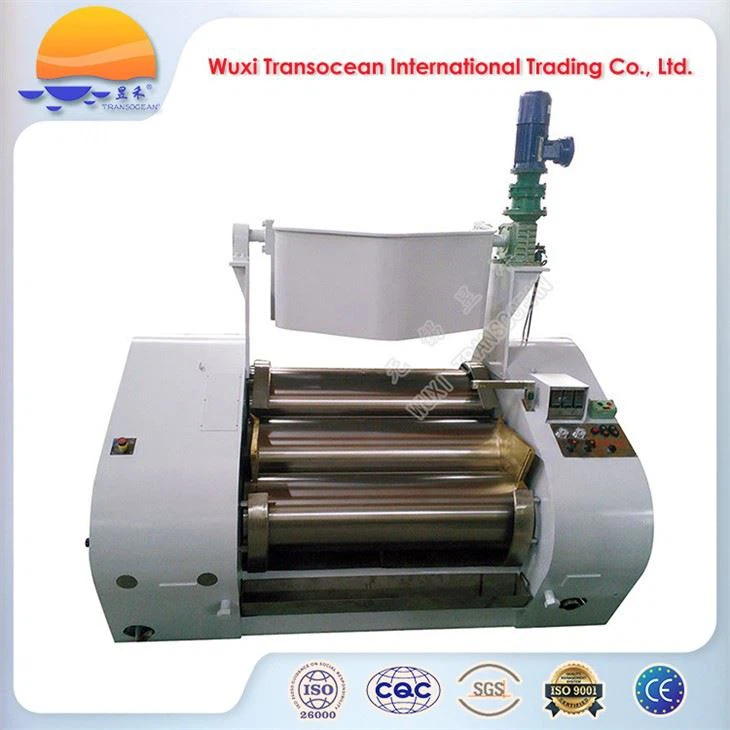
A triple roller grinder, also known as a three - roll mill, mainly consists of three horizontally arranged rollers that rotate at different speeds. The basic working principle is that the material is fed between the slow - moving and the medium - speed rollers, and as it passes through the ever - narrowing gap between the rollers, the size of the material particles is reduced due to the shearing and crushing forces generated by the relative motion of the rollers.
When it comes to the use of triple roller grinders, they are more commonly associated with wet grinding. In wet grinding applications such as the production of paint, coatings, and pigment pastes, the liquid carrier helps to reduce friction, disperse the particles more evenly, and prevent the material from sticking to the rollers. For example, in the production of Triple Roller Mill for Paint, the paint components are mixed with solvents or binders, which are then fed into the triple roller grinder to achieve a fine and uniform dispersion of pigments and other solid particles in the liquid phase.
Feasibility of Dry Grinding with Triple Roller Grinders
In theory, triple roller grinders can be used for dry grinding, but there are several significant challenges that need to be addressed.
Heat Generation
One of the most prominent problems in dry grinding is heat generation. Without the cooling effect of a liquid medium, the friction between the material and the rollers, as well as between the material particles themselves, can cause a rapid increase in temperature. High temperatures can lead to several negative consequences. For instance, it may cause the material to undergo thermal decomposition, especially for heat - sensitive substances. In addition, excessive heat can also cause the rollers to expand, which may affect the precision of the grinding gap and ultimately reduce the quality of the grinding results.

Dust and Contamination
Dry grinding generates a large amount of dust. This not only poses a health risk to the operators but also can contaminate the working environment. Moreover, the dust can enter the mechanical parts of the grinder, such as bearings and gears, which may lead to accelerated wear and tear of the equipment and reduce its service life. From a product quality perspective, dust redeposition can also lead to inconsistent particle size distribution in the final product.
Material Adhesion
In the absence of a liquid carrier, the ground material may tend to stick to the rollers. This can disrupt the normal operation of the grinder, reduce the efficiency of material processing, and make the cleaning and maintenance of the equipment more difficult.
Conditions for Successful Dry Grinding with Triple Roller Grinders
Although there are challenges, under certain conditions, triple roller grinders can still perform dry grinding effectively.
Material Properties
The physical and chemical properties of the material play a crucial role. Materials with low moisture content, good flowability, and high heat resistance are more suitable for dry grinding. For example, some inorganic minerals like quartz or talc can be ground dry, as they have relatively high melting points and do not easily decompose under the frictional heat generated during grinding.
Grinder Modifications
Making appropriate modifications to the triple roller grinder can also enhance its performance in dry grinding. For example, installing better cooling systems around the rollers can help to dissipate heat and maintain a stable operating temperature. Additionally, adding anti - adhesion coatings to the rollers can reduce the problem of material sticking. Some advanced triple roller grinders are also equipped with enclosed dust - collection systems to minimize dust pollution.
Process Control
Strict process control is essential for successful dry grinding. This includes accurately controlling the feed rate of the material, the speed ratio of the rollers, and the grinding time. By carefully adjusting these parameters, operators can ensure that the grinding process is carried out efficiently while minimizing the negative effects of heat generation, dust, and adhesion.
Advantages of Dry Grinding with Triple Roller Grinders
If the challenges are overcome, dry grinding with triple roller grinders has several advantages.
No Need for Solvents
Dry grinding eliminates the need for solvents, which is not only cost - effective but also environmentally friendly. In some applications, such as the production of certain high - purity powders, avoiding the use of solvents can help to ensure the purity of the final product.
Simplicity of Process
Compared to wet grinding, which often requires additional steps such as solvent evaporation and drying after grinding, dry grinding is a more straightforward process. This can lead to increased production efficiency and reduced processing time.
Industry Applications of Dry Grinding with Triple Roller Grinders
There are several industries where dry grinding with triple roller grinders can be applied.
Ceramics Industry
In the ceramics industry, triple roller grinders can be used to dry - grind raw materials such as clay, feldspar, and quartz to obtain fine particles with a narrow size distribution. These finely ground materials are essential for producing high - quality ceramic products with good mechanical properties and a smooth surface finish.
Electronics Industry
The production of certain electronic materials, such as fine metal powders and ceramic powders used in capacitors and resistors, may also involve dry grinding with triple roller grinders. Precise control of particle size is crucial for the performance of electronic components, and the triple roller grinder can provide the necessary grinding accuracy.
Conclusion
In conclusion, while triple roller grinders are more commonly used for wet grinding, they can be used for dry grinding under certain conditions. Although there are challenges such as heat generation, dust, and material adhesion, with proper material selection, grinder modifications, and process control, successful dry grinding operations can be achieved. The advantages of dry grinding, such as the elimination of solvents and process simplicity, make it an attractive option for some industries.
If you are considering using a triple roller grinder for dry grinding or have any other related needs, we, as a professional supplier, are here to offer you the most suitable solutions. Our Coating Three Roller Grinding Mill and Pigment Paste Three Roll Mill are also available for various wet - grinding applications. We welcome you to contact us for more information and to discuss your specific procurement requirements. We are confident that our expertise and high - quality products will meet your expectations.
References
- Rumpf, H. (1975). Fine Comminution and Particle Size Enlargement. Chemical Engineering Science, 30(10), 1701 - 1712.
- Sastry, K. V. S. (2002). Mineral Processing Technology: An Introduction to the Practical Aspects of Ore Treatment and Mineral Recovery. Butterworth - Heinemann.


