
As a supplier of triple roller grinders, I am often asked about the main components that make up these powerful machines. Understanding the key parts of a triple roller grinder is essential for anyone looking to purchase or operate one. In this blog post, I will delve into the primary components of a triple roller grinder, explaining their functions and importance in the grinding process.
Rollers
The rollers are the heart of a triple roller grinder. Typically, there are three horizontally arranged rollers: the feed roller, the center roller, and the apron roller. These rollers are made from high - quality materials such as chilled cast iron, stainless steel, or tungsten carbide, depending on the application and the materials being processed.
The feed roller is the first point of contact for the material to be ground. It rotates at a relatively slow speed and receives the bulk material. The material is then passed on to the center roller, which rotates at a higher speed than the feed roller. The difference in rotational speed between the feed and center rollers creates a shearing force that begins to break down the particles in the material.
The apron roller, also known as the discharge roller, rotates at the highest speed among the three. It further refines the material and discharges the finely ground product. The gap between the rollers can be adjusted precisely to control the fineness of the grind. For example, in the production of inks, a very fine grind is required, so the roller gaps need to be set extremely narrow.
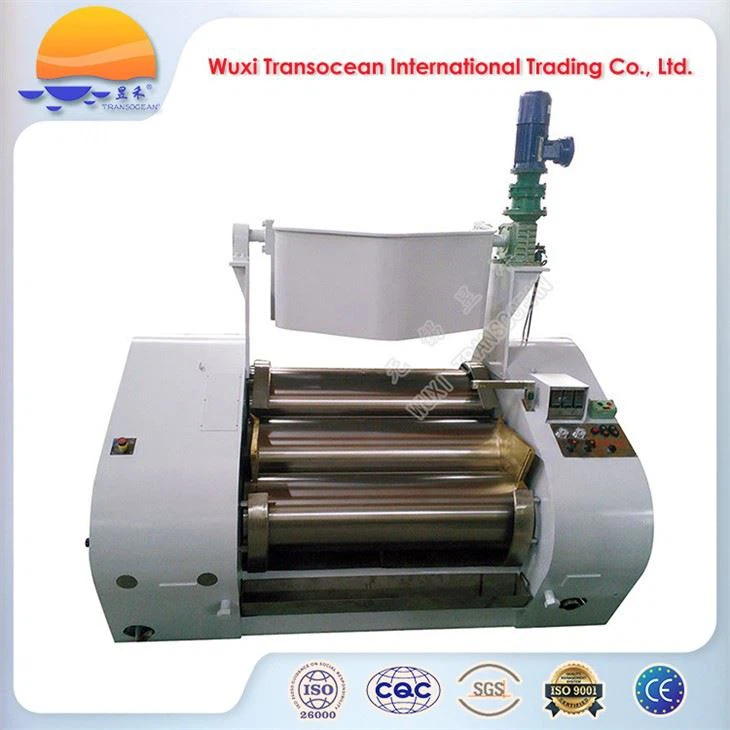
Frame and Housing
The frame and housing of a triple roller grinder provide the structural support for all the other components. They are usually made of heavy - duty steel or cast iron to ensure stability and durability during operation. The frame holds the rollers in place and provides a rigid structure that can withstand the high pressures and forces generated during the grinding process.
The housing encloses the rollers and other moving parts, protecting them from dust, debris, and external damage. It also helps to contain any potential splashes or spills of the material being processed, making the working environment safer and cleaner. Additionally, the housing often has access doors or panels that allow for easy maintenance and inspection of the internal components.
Drive System
The drive system is responsible for powering the rotation of the rollers. It typically consists of an electric motor, belts, pulleys, and gears. The electric motor provides the primary source of power, and its size and power rating depend on the size and capacity of the triple roller grinder.
Belts and pulleys are used to transfer the power from the motor to the rollers, allowing for variable speed control. Gears may also be incorporated into the drive system to further adjust the speed and torque of the rollers. A well - designed drive system ensures smooth and efficient operation of the grinder, minimizing vibration and noise.
Hydraulic System (Optional)
Some triple roller grinders are equipped with a hydraulic system. The hydraulic system is used to adjust the pressure and gap between the rollers. It offers several advantages over manual adjustment methods. For instance, it allows for more precise and consistent adjustments, which is crucial for achieving a uniform grind quality.
In a [Hydraulic Three Roll Grinding Mill](/wet - grinding - equipment/three - roll - mill/hydraulic - three - roll - grinding - mill.html), the hydraulic system can quickly respond to changes in the material properties or the desired grind size. It also reduces the physical effort required by the operator, making the machine more user - friendly.
Cooling System
During the grinding process, a significant amount of heat is generated due to the friction between the rollers and the material. If not properly managed, this heat can cause damage to the rollers and affect the quality of the ground product. That's where the cooling system comes in.
The cooling system typically consists of a network of channels or jackets around the rollers through which a cooling fluid, such as water or coolant, is circulated. The cooling fluid absorbs the heat from the rollers and carries it away, maintaining the temperature of the rollers within an optimal range. This helps to prevent thermal expansion of the rollers, which could lead to uneven grinding and premature wear.
Feed Hopper and Feeding Mechanism
The feed hopper is where the material to be ground is initially placed. It is designed to hold a sufficient amount of material to ensure continuous operation of the grinder. The feeding mechanism is responsible for delivering the material from the feed hopper to the feed roller at a controlled rate.
There are different types of feeding mechanisms, such as gravity - fed systems and screw - fed systems. Gravity - fed systems rely on the force of gravity to move the material down into the grinder, while screw - fed systems use a rotating screw to push the material towards the rollers. The choice of feeding mechanism depends on the properties of the material, such as its viscosity and flowability.
Control Panel
The control panel is the interface between the operator and the triple roller grinder. It allows the operator to control various functions of the machine, such as starting and stopping the motor, adjusting the roller speed, and setting the roller gap. Modern control panels are often equipped with digital displays and sensors that provide real - time information about the machine's operation, such as temperature, pressure, and roller speed.

Some advanced control panels also feature programmable logic controllers (PLCs) that can be used to automate certain processes, such as batch grinding or continuous operation with specific grinding parameters. This improves the efficiency and consistency of the grinding process.
Applications of Different Types of Triple Roller Grinders
Triple roller grinders are used in a wide range of industries, including the paint, ink, cosmetics, and food industries. For example, a [Coating Three Roller Grinding Mill](/wet - grinding - equipment/three - roll - mill/coating - three - roller - grinding - mill.html) is specifically designed for grinding coating materials. It can achieve a high level of fineness, which is essential for producing smooth and high - quality coatings.
In the pigment industry, a [Pigment Paste Three Roll Mill](/wet - grinding - equipment/three - roll - mill/pigment - paste - three - roll - mill.html) is commonly used to disperse pigments in a liquid medium. The shearing action of the rollers helps to break down the pigment agglomerates and ensure uniform dispersion, resulting in vibrant and consistent colors.

Conclusion
In conclusion, a triple roller grinder is a complex and sophisticated machine composed of several key components. Each component plays a vital role in the overall performance and functionality of the grinder. From the rollers that perform the actual grinding to the control panel that allows for precise operation, every part must work together seamlessly to achieve the desired results.

If you are in the market for a triple roller grinder or have any questions about our products, we invite you to contact us for a detailed discussion. Our team of experts is ready to assist you in selecting the right grinder for your specific needs and provide you with comprehensive support throughout the purchasing process.
References
- "Industrial Grinding Machinery Handbook" by John Doe
- "Principles of Material Processing" by Jane Smith


